
INSIGHTS · QUANTITATIVE TRADING
When Everyone Has the Same Data, Where Does Alpha Come From?
As access to market data becomes increasingly widespread, the competitive advantage may no longer lie in possessing information — but in how that information is interpreted, transformed and ultimately translated into decisions.
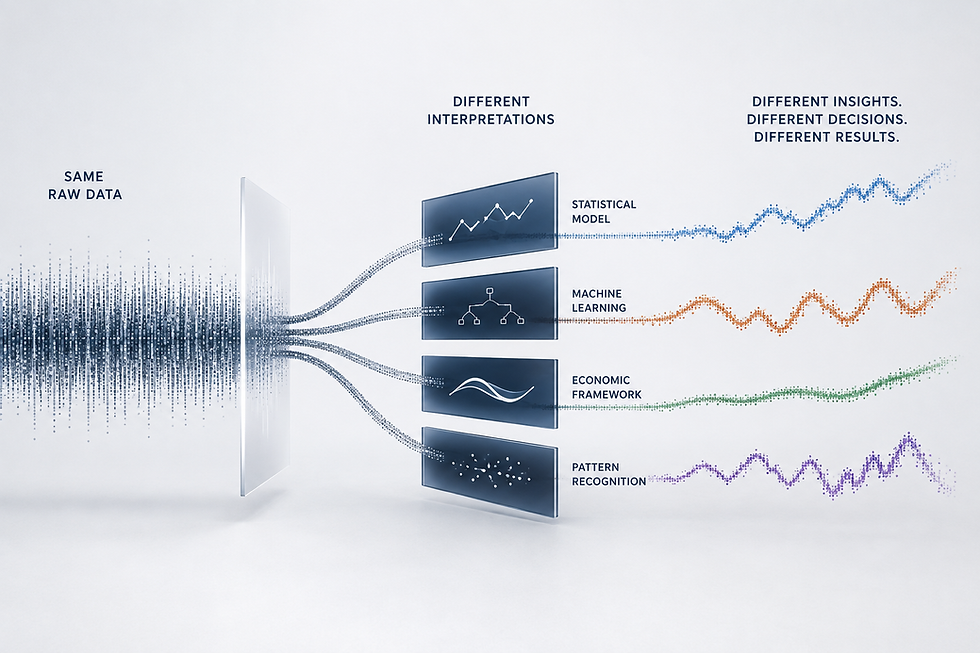
Financial markets have never contained more data.
Prices, volumes, economic indicators, corporate information and countless other variables can be collected, processed and analyzed at a scale that would have been difficult to imagine only a few decades ago.
At the same time, access to many of these data sources has become increasingly widespread. Information that was once expensive, slow or available only to a relatively small group of market participants can now often be accessed almost instantly.
This creates an interesting paradox. If more investors can observe the same markets, process similar datasets and use increasingly sophisticated analytical tools, why do their conclusions — and their results — remain so different?
Perhaps the answer is that data itself was never the real source of differentiation.
The advantage may lie in what happens after the data arrives.
Data is not information
Having access to data does not automatically create an informational advantage. The same dataset can support very different conclusions depending on how it is selected, structured and interpreted.
Raw market data contains observations. Turning those observations into something useful requires decisions: which variables matter, over what time horizon they should be examined, how they should be transformed and which relationships are worth testing.
Two researchers can therefore begin with exactly the same data and arrive at entirely different signals. One may focus on momentum, another on volatility, liquidity, relative relationships or changes in market behavior. The underlying observations may be identical, while the information extracted from them is not.
This distinction becomes increasingly important as access to data becomes more democratized. When scarcity of information decreases, the ability to separate relevant structure from noise becomes more valuable.
The competitive question therefore shifts from “What data do we have?” to “What can we discover within it?”
Alpha begins with interpretation
If many market participants can access similar information, differentiation increasingly depends on the questions they ask of that information.
A dataset does not determine how it should be interpreted. Researchers decide which relationships to investigate, which assumptions to challenge and which observations may contain information about market behavior. These choices shape everything that follows.
The same price series, for example, can be examined for trends, reversals, changes in volatility, relationships between markets or shifts in the behavior of participants. None of these interpretations is contained explicitly within the raw observations. They emerge from the framework applied to them.
This is why quantitative research is not simply a process of processing ever larger amounts of data. It is also a process of formulating hypotheses that can transform observations into testable ideas.
The potential source of differentiation therefore moves one step further away from the data itself: from access to interpretation, and from interpretation to hypothesis.
A good idea is not yet a model
A compelling hypothesis can be the beginning of quantitative research, but it is not its conclusion. Markets contain enough variation that convincing patterns can often be found — particularly when enough variables, time periods and transformations are examined.
The challenge is determining whether an observed relationship contains meaningful information or simply reflects coincidence within a particular dataset.
This requires discipline in how hypotheses are tested. Researchers need to examine whether relationships persist outside the observations in which they were discovered, how sensitive they are to changing assumptions and whether they remain relevant across different market environments.
The distinction is important because increasingly powerful analytical tools can make it easier to discover patterns without necessarily making those patterns more meaningful. Greater computational capability expands both the opportunity for discovery and the risk of finding structure where none truly exists.
Alpha, therefore, cannot be reduced to finding an interesting pattern. The harder task is determining which patterns deserve to survive the research process.
A signal is not a result
Identifying a robust signal does not automatically translate into a successful market outcome. Between research and implementation lies another layer of decisions that can materially influence what ultimately happens.
Position sizing, portfolio construction, transaction costs, liquidity and execution all affect how a theoretical opportunity behaves once it encounters real markets. A relationship that appears meaningful in research may become considerably less attractive when these practical constraints are introduced.
Risk management adds another dimension. Even a signal with a favorable statistical profile can experience periods in which expected relationships weaken or outcomes move against the model. How exposure is managed during those periods can be as important as the signal itself.
This means that potential differentiation can emerge throughout the entire process — not only from discovering information, but from how that information is converted into decisions and how those decisions are implemented.
Alpha, viewed this way, is less likely to originate from a single exceptional insight. It may instead emerge from the combined quality of many decisions across the research and implementation process.
When everyone has access to the same data, differentiation may come not from what the market reveals — but from what you are able to discover within it.
Advantage does not stand still
Any source of differentiation in financial markets exists within a competitive environment. Once an idea, technique or source of information becomes widely understood, the advantage associated with it may begin to change.
Markets adapt because participants adapt. New technologies spread, analytical methods become more accessible and successful approaches attract attention. What once required specialized infrastructure or expertise can gradually become available to a much broader group of market participants.
This does not mean that better tools or broader access eliminate the possibility of differentiation. It means that the frontier moves. As one advantage becomes more widely available, researchers must continue questioning assumptions, refining methods and exploring new ways of interpreting market behavior.
Alpha may therefore be less about discovering a permanent secret hidden inside the data and more about maintaining a research process capable of evolving as markets evolve.
In that sense, the question “Where does alpha come from?” may never have a permanent answer — because the sources of differentiation themselves are constantly changing.
CLOSING THOUGHT
Data may become widely available. The ability to extract meaning from it does not.
As markets, technologies and analytical tools continue to evolve, differentiation is unlikely to depend on a single dataset, model or discovery. It emerges from the quality of the entire process — from asking the right questions to testing ideas rigorously and translating them into disciplined decisions.
The search for alpha may therefore be less about finding information that nobody else possesses and more about seeing something different in information that everyone can access.
CONTINUE EXPLORING
RESEARCH NOTE
FINOVIS Insights explore ideas, methods and developments related to quantitative finance, financial markets and technology. They are provided for informational and research purposes only and do not constitute investment advice or a recommendation to engage in any investment strategy.